

AGM vs EFB vs Standard Flooded Batteries: What’s the Difference and Which One Do You Need?

Not all car batteries are created equal. Today’s vehicles demand more power than ever, and choosing the right battery technology matters just as much as choosing the right size.
If you’ve ever seen terms like AGM, EFB, or Standard Flooded and wondered what they really mean, you’re not alone. This guide breaks down the differences between these three battery technologies, explains where each one fits, and helps ensure you choose the correct replacement for your vehicle.
Why Battery Technology Matters More Than Ever
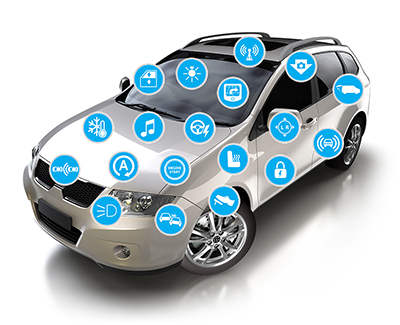
Modern vehicles do far more than start an engine. From start-stop systems and advanced safety features to infotainment, cameras, and climate controls, today’s electrical demands are constant and complex.
That’s why battery technology has evolved. The battery that worked in older vehicles may no longer be capable of supporting newer ones, especially those with start-stop technology or high electrical loads.
Choosing the wrong battery can lead to:
Shortened battery life
Reduced performance
Start-stop system malfunctions
Repeated replacements
Electrical Issues
Understanding the differences between AGM, EFB, and Standard Flooded batteries helps prevent these issues.
AGM Batteries (Absorbent Glass Mat)
AGM batteries are the highest-performing lead-acid battery technology available today.
AGM batteries use absorbent glass mat separators that hold the electrolyte in place, rather than allowing it to flow freely. This design supports consistent performance, higher durability, and superior cycling capability. Without the presence of free-flowing acid, AGM batteries are nonspillable and the safest batteries on the market today.
AGM batteries are recommended for:
All start-stop vehicles
Vehicles with high electrical demands
Hybrid and electric vehicles
Vehicles with an OE-installed AGM battery
Trunk or passenger compartment installations
High-temperature environments
Drivers who take frequent short trips or sit in traffic
Key benefits of AGM:
Up to 2X longer life than standard flooded batteries
Superior repetitive cycling for start-stop systems
Strong starting power, even at low state of charge
Non-spillable design for improved safety
Excellent vibration resistance
Can be used to replace all battery technologies – SLI, EFB, and AGM
Replacement rule:
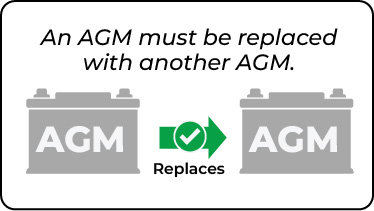
If your vehicle came with an AGM battery, it must be replaced with an AGM battery.
AGM is not interchangeable with EFB or standard flooded batteries. AGM can replace AGM, SLI and EFB. SLI and EFB should never replace AGM.
EFB (Enhanced Flooded Battery)
EFB are an enhanced version of a standard flooded battery, designed to handle moderate cycling demands.
EFB technology improves on traditional flooded batteries through enhanced paste formulations and internal components, but the electrolyte still flows freely inside the battery.
EFB are typically used for:
Select low-demand start-stop vehicles
Vehicles with moderate electrical loads
What EFB offers:
Better cycling capability than standard flooded batteries
Reliable starting power
Maintenance-free operation
Important limitations of EFB:
Limitations in high temperature environments
Not designed for high electrical demands
Designed for vehicle specific requirements; no universal aftermarket replacement battery is available
Free flowing acid limits in vehicle usage
More susceptible to acid stratification over time
Shorter lifespan compared to AGM
Replacement guidance:
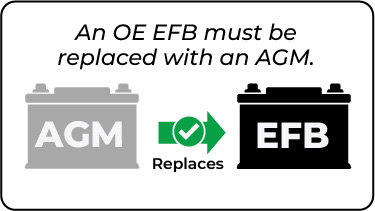
An OE EFB battery should be replaced with AGM as there is no EFB battery designed to handle the vehicle specific battery requirements.
If your vehicle was originally equipped with an AGM battery, it must always be replaced with AGM.
AGM is always the preferred replacement because it delivers higher performance, longer life, and greater reliability.
Standard Flooded Batteries (Starting, Lighting, and Ignition)
Standard Flooded batteries, often referred to as SLI (Starting, Lighting, and Ignition) batteries, are the most traditional battery type.
They use free-flowing electrolyte and are designed primarily to provide starting power, not sustained cycling.
Standard Flooded batteries are best for:
- Older vehicles without start-stop technology
Vehicles with minimal electrical features
Short-term or basic driving needs
What to know:
Designed mainly for engine starting
Limited cycling capability
Not suitable for start-stop vehicles
Not recommended for modern vehicles with advanced electronics
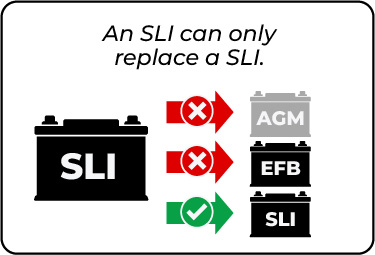
Standard flooded batteries should not be used as replacements for AGM or EFB batteries.
AGM vs EFB vs Standard Flooded: Quick Comparison
AGM: Best for modern vehicles, start-stop systems, high electrical demand, and long-term reliability
EFB: A step up from standard flooded, suitable for select low-demand start-stop vehicles
Standard Flooded: Best for older, low-demand vehicles without advanced electrical systems
Choosing the Right Replacement Battery
When it comes to replacement, following the original battery technology is critical.
Key rule to remember: If your vehicle was originally equipped with an AGM battery, AGM should always be the replacement.
While EFB may appear similar, it does not deliver the same performance, cycling capability, or long-term durability. AGM is the best solution for today’s vehicles and helps ensure your electrical systems operate as designed.
Find the Right Battery for Your Vehicle
The easiest way to make sure you’re choosing the correct battery is to match both battery size and technology to your vehicle’s requirements.
Use the Battery Finder on AutoBatteries.com to quickly identify the right option based on your vehicle and driving needs.
Choosing the right battery today helps protect your vehicle’s performance tomorrow.